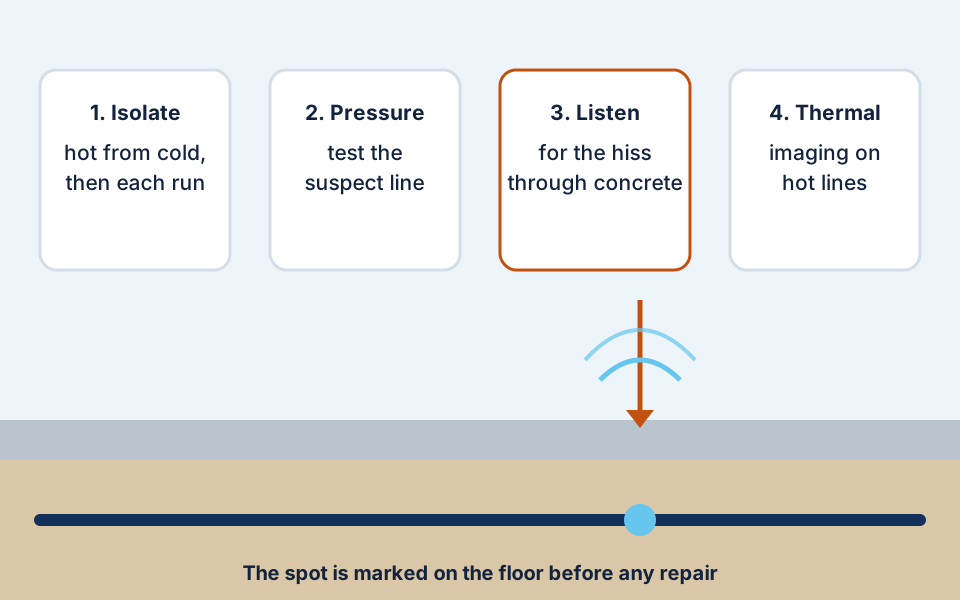
Professionals find slab leaks without breaking the floor by narrowing the search in steps: isolate the leaking line, confirm it with a pressure test, then listen and look for the exact spot. Knowing the methods helps you ask good questions and understand the result.
Step one: isolate the line
The search starts at the meter. Shutting off the water heater's cold supply separates hot from cold. Closing valves at fixtures or manifolds separates individual runs. Each split cuts the search area, and by the end the professional knows which line is losing water.
Pressure testing
A section of pipe is isolated and pressurized, and a gauge shows whether it holds. A falling gauge confirms that section leaks. It's how a leak detection professional proves which line is leaking before anyone talks about a repair.
Acoustic listening
Water escaping a pressurized pipe makes a hiss that travels through concrete. Listening equipment with sensitive ground microphones picks it up, and the professional moves along the line's path until the sound is loudest. That's usually where the leak is. Background noise, such as a running appliance or traffic, can get in the way, which is why the house is kept quiet during the search.
Thermal imaging
On hot water lines, a thermal camera shows the warm path of the pipe and the warmer patch where water escapes. It's less useful on cold lines, where the temperature difference is small. The warm spot guide covers what a hot-side leak feels like from above.
Line tracing and tracer gas
Electronic line locators trace where a pipe actually runs under the floor, which matters because pipes rarely follow the path you'd guess. Some professionals also use tracer gas: the line is drained and filled with a harmless gas mix, and a detector finds where it escapes through the slab.
When the search ends
The methods end in a marked spot, and the slab leak detection page lists what the written result should say before you move on to repair options. When you're ready for the search itself, request a leak inspection.