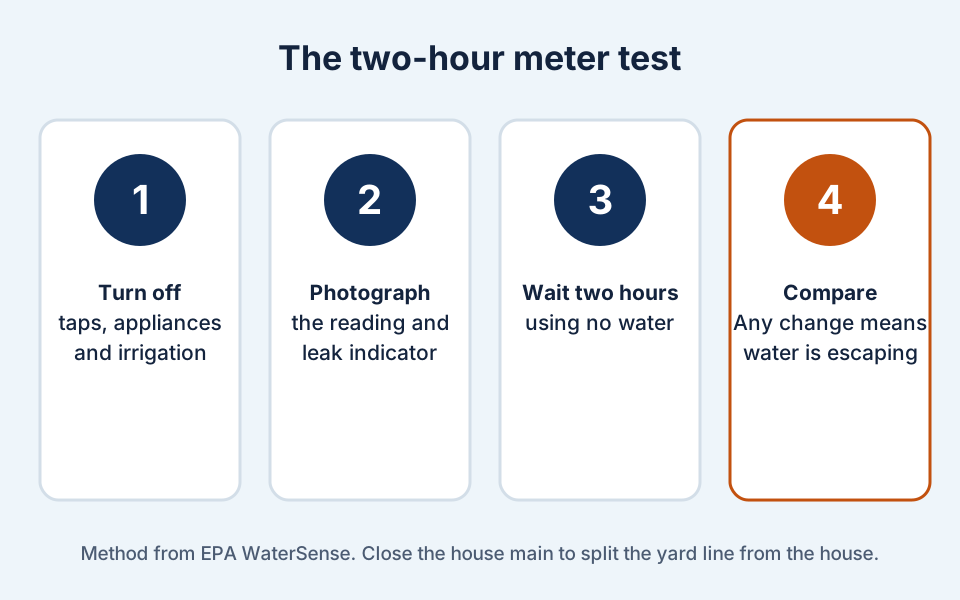
To check for a leak, read your water meter, use no water for two hours, then read it again. If the number moved, water is escaping somewhere. That test comes from EPA WaterSense, needs no tools, and is the single most useful thing you can do before calling anyone.
Find your meter
In most neighborhoods the meter sits in a rectangular box in the ground near the street or sidewalk, often near a property corner. Lift the lid carefully. Desert critters like these boxes, so look before you reach in. Your water provider's name may be on the lid. In Goodyear that's the City south of I-10, or EPCOR or Liberty Utilities north of it.
Read the dial and the leak indicator
Most meters show a running total in gallons or cubic feet, plus a small leak indicator. On dial meters it's often a small triangle or star that spins with even a tiny flow. Digital meters may show a flow rate or a leak symbol. Take a photo of the reading so you don't have to remember it.
Run the two-hour test
Pick a time when the house can go without water, such as overnight. Turn off the irrigation controller, and make sure the dishwasher, washer and softener aren't running. Don't flush. Photograph the meter, wait two hours, and photograph it again.
- Turn off irrigation and every water-using appliance.
- Photograph the reading and the leak indicator.
- Use no water for two hours.
- Photograph again and compare.
Split the house from the yard
If the meter moved, close the main shutoff valve where the line enters the house and watch the leak indicator. If it stops, the leak is inside the house: the slab, a wall, or a fixture. If it keeps moving with the house closed, the leak is in the service line or the irrigation supply. Our guide on when to shut off your water shows where the main valve usually is.
Split hot from cold
With the house main open again, the same meter can split hot from cold using one valve at the water heater, a check the warm spot guide walks through. Whatever it shows is worth reporting, because it halves the search.
What your result means
A still meter means no active leak right now. A moving meter means a leak, and the splits above tell you roughly where. Write down what you found and request a leak inspection. The professional can start where your test left off.