When a Canyon Trails home shows signs of a leak, we set up a leak detection visit to find the source before anything is opened. Canyon Trails sits south of I-10 around Sarival Avenue and Cotton Lane, near Loop 303, and it was built in stages from 2001 into the 2020s by a long list of builders, so the first questions depend on which part of it you live in.
Built in stages from 2001 to the 2020s
Maricopa County Assessor records show Canyon Trails going up in waves. Phase 1 and Unit 2, about 1,290 lots built by Continental Homes, date mostly from 2001 to 2004. Most of Unit 3 and Unit 4 followed from about 2005 to 2012, from builders including Standard Pacific, Taylor Woodrow, Centex, Pulte, Shea and Beazer, and parcels such as Crestwood at Canyon Trails and Bella Rosa went up around 2019 to 2021.
So the first conversation depends on your parcel. In a Phase 1 or Unit 2 home, now more than 20 years old, ask about earlier plumbing repairs and the pipe near the leak. In one of the newest parcels, the builder's coverage may still apply, as the Sedella page explains.
What the builders' soil reports say about water
Each parcel's subdivision public report, filed with the Arizona Department of Real Estate, quotes the builders' soils engineers. The Phase 1 report describes former farmland it calls "potentially compressible" and says "water should not be allowed to saturate the soil near the structure." The Unit 4 West report warns of "a high settlement potential when subjected to moisture under structure loads."
A slab leak wets that ground from below, so in Canyon Trails a suspected leak is worth tracking down rather than watching, and new cracks in tile or drywall, or a door that started sticking, are worth mentioning in your request. The reports also show that slabs vary: Phase 1 was designed with a conventional footing, stem and slab, while the Unit 3 reports allow conventional or post-tensioned slabs, so check your own garage floor for a stamp.
Rule out the yard first
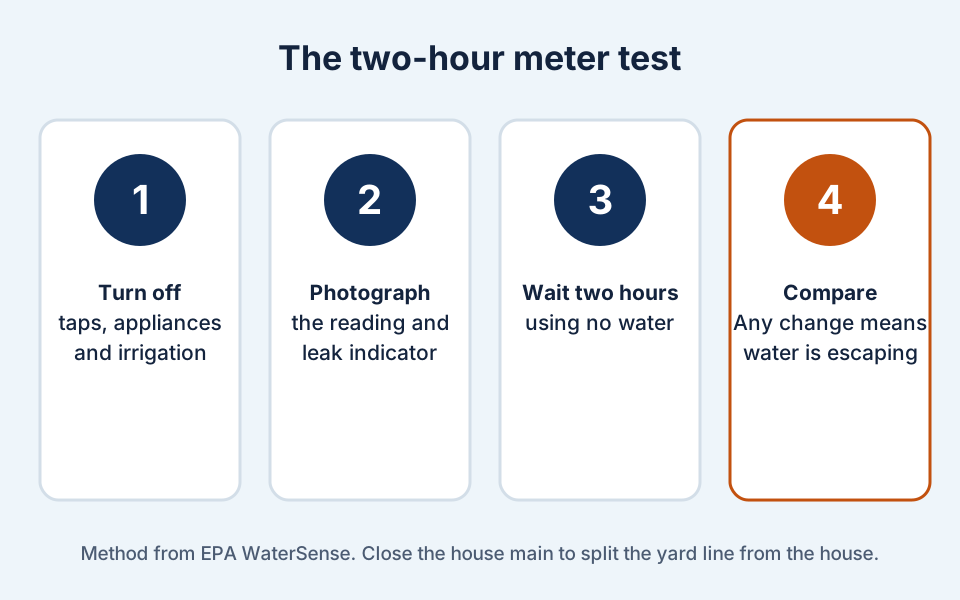
Many desert yards use drip irrigation on a controller. A cracked drip line or a stuck valve can raise a bill for weeks without a visible puddle in gravel. Before booking a slab search, shut off the irrigation supply and run the two-hour meter test. If the meter stops, check the yard. If it keeps moving with irrigation off, the house moves to the top of the list.
HOA rules differ by unit
Canyon Trails has several HOAs, not one. The City's 2025 list of water-efficient partners names HOA 1 & 2, Unit 3, Unit 4 West (Oasis), Unit 4 South and Crestwood at Canyon Trails separately, so read your own unit's documents before any outdoor work.
In Unit 3, the recorded CC&Rs require the Architectural Committee's prior written approval to excavate on a lot, and its review form allows 60 days, so if the yard line has to be dug up, send the request as soon as you have a leak location. Unit 3 owners also maintain the boulevard strip at the curb. A wet patch there while your meter is still may be on the City's side, since Goodyear notes that leaks on its side do not run through the meter.
What to have ready before the visit
Telling us what you've already ruled out helps the slab leak detection visit start in the right place, or move on to water leak detection if the leak is in a wall. These details help most:
- Irrigation ruled out with the supply closed
- Your unit or parcel, year built and any builder paperwork
- Hot or cold side
- Any recent remodel or new fixture work
Who handles the repair
Once the leak is marked in a home past its builder coverage, the repair options guide explains spot repair, rerouting and lining.
Estrella, Centerra and Las Brisas are nearby communities south of I-10.